Interim General Manager for Healthcare Founders
People keep asking what I do. Here’s the answer, and why healthcare founders need it.

A little over a year ago I had an urgent health crisis that required immediate, but not emergency, care. I had been researching healthcare delivery and financing for a while and I thought ‘Well, that’s lucky — now seems like as good an opportunity as any to try to price-shop my healthcare services.’
I’d bought a high-deductible bronze plan on the exchange as a stopgap after the COBRA from my last role ran out, and never planned to use it unless it was, well, catastrophic. Then came months of unchecked bleeding, and as my iron counts began to drop, my doctor’s concern started to ramp. The team ordered tests left and right: ultrasounds, bloodwork, eventually MRIs. The uncertainty of what was going on was stressful, but the real headache came from project-managing getting an MRI.
Inspired by Mark Cuban’s viral advice to ask for the cash price, I decided to price out my options. My doctor’s own hospital system called me within hours of my receiving my doctor’s order, but when I asked what the out-of-pocket price would be, it took several transfers only to be told it would take several days to get me that number. In the meantime, I contacted 8 facilities within a 100-mile radius of my home in Austin.
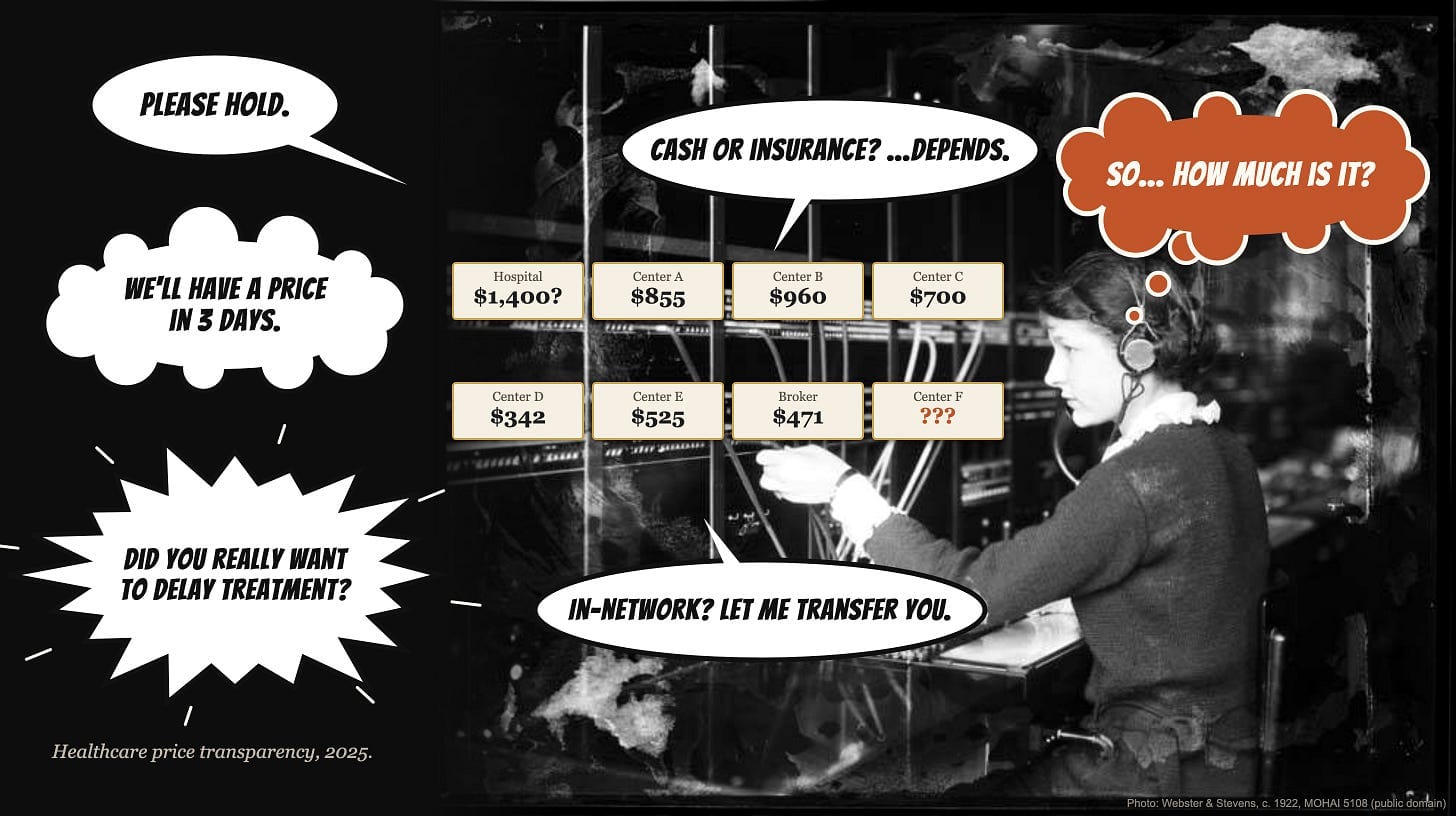
I plotted each center, each cost, each requirement, and the soonest available date in a spreadsheet. Nobody had their prices online, and each quote required a game of phone and email tag. Some never even got back to me. Then I called my insurance to confirm every “in-network” claim. One center swore it took my plan; my insurer said it didn’t. Another billed insurance $1,900 for a scan my insurer said should cost me $535. The hospital finally quoted me $1,400 out of pocket, and wouldn’t say whether that was cash or my copay. Cash prices elsewhere ran from $471 to $960. In the end, an imaging center took my insurance for a $342 copay. The South Austin location had a month’s wait; the one in Marble Falls, about 50 miles away, could take me in a week. So I drove. If it hadn’t been for my sheer intellectual curiosity and commitment to finishing the test, I probably would’ve paid the $1,400. Instead, the MRI with contrast was completed, imaging shared, no surprises.
When we talk about comparison shopping for our health procedures, this is what we’re actually talking about. And while I had a pressing need, it wasn’t an emergency. I also had the time and commitment to see it through. But what if I’m a single parent working full-time with two kids? A child of an aging parent who needs procedure after procedure?
Americans know they’re getting hosed, and they’re mad — but are they willing to do something about it?
Short answer? No. A health policy analyst tried to price-shop a CT scan and this spring titled his write-up “I tried price shopping for health care. It isn’t worth it – not yet.” Even among the people who paid out of pocket for care — the people most incentivized to shop around and compare costs — only 3% of them did it.
And how can we blame them? We’ve made healthcare too complicated, and people are just checked out. And so we’re forcing the check back in when something dire, traumatic, and expensive happens, and that’s not a good place to get people to think about the investment in their health or how to make anything better.
But “not yet” is the opportunity, and I see two frontiers:
First: healthcare delivery and cash pay. How do you show people that cash pay, even if they’re a middle-class or working-class person who doesn’t qualify for government aid, is worthwhile?
Second: healthcare financing. How can we make it super clear to people that their investment in their health is an investment in their future, and it will lead to cheaper, better outcomes for their health and their financial security?
This is the problem that I have dedicated this next chapter in my life to help solve, and I want to help founders who are thinking like me about this problem.
I don’t have the solution but I do have the skills and experience to help those healthcare founders who do have an answer, and need the help of a general contractor who can manage their market entry and go to market.
I am an interim General Manager (GM). I come in to help shepherd your new market or new product idea through a process that ultimately lets you decide: stop, go, or adjust.
The current alternative to hiring for this work is a founder saying ‘but I can do that’ or, if cognizant of the value of their time, ‘I can create the strategy and hand it off to some product manager.’ Either the founder becomes distracted from their core deliverable — managing the entire company — or they launch a product that never gets market tested, never gets regulatorily derisked, and is never taken seriously by their team because it’s always pushed as a side project next to that team member’s ‘real’ job. At best, a product is launched to silence; at worst, the product is launched and met with regulatory inquiry.
Of course you can outsource this work across multiple firms too — a research firm, a GTM firm, a government relations and regulatory firm, an advisory firm, a product firm, and an operations firm. And your outside counsel on retainer? Their billable hours will skyrocket working with each of those consultants to ensure you don’t wind up in court or having to pursue legal action. And while each of their specialized services may be needed at some point — right now you need someone who can prioritize your needs and pull in the specialists only when needed.
By hiring an interim GM, you are bringing on someone who has seen how the whole game is played, the roles each of these firms (or full-time employees) play, and can help you make a strategic decision once you’ve launched on which services are needed to sustain momentum and which ones would cost you time and resources you don’t need to spend.
This is how the process works:
- Discovery: Hear the hard truths through raw discovery — without leading the witness.
- Regulatory read: Determine your standing to operate and accept known legal risk.
- Internal game plan: With full leadership support, determine the organizational responsibilities for launch and collaborate with teams to ensure 100% buy-in.
- Launch: Launch the product to a market that wants it; don’t push a solution in search of a problem.
- Hand off: Interim engagement ends: hand off something durable with a clear growth path forward.
And a few examples where the “discovery” and “regulatory reads” changed the internal game plan and launch — and the call: stop, go, or adjust:
ADJUST
A pre-product, seed-stage Medicaid enrollment startup partnered with a hospital system where up to 65% of patients were uninsured or underinsured, and most of its ER patients came in on charity care or self-pay. After interviewing government officials, competitors and partners, support personnel and care providers, and employees, the clearest problem that emerged was patients appearing in the ER with no ability to pay for care received. Developed product requirements documentation for the Medicaid enrollment system.
Outcome: Recommendation to focus on product development; too early for go-to-market.
GO
General Motors acquired Cruise Automation for roughly $1B to diversify into self-driving, and Cruise had no external-facing employees while driverless cars trained on city streets. The problem was derisking existing markets, identifying how to mitigate risk in new potential markets, and how to systematically approach a greenfield market. Developed a framework for measuring the probability of legislative success in each potential market, grew the External Affairs team from zero to eight people and a dozen-plus consultants covering every global geography, and obtained a $2.5M budget to support these efforts.
Outcome: Created a regulatory model as a direct input to the driverless business model. Secured California’s final driverless testing regulations and inclusion in New York’s state budget.
ADJUST
Two years after its Series A, lead flow at a no-code data infrastructure platform startup had stalled, 6 months of runway remained, and the go-to-market team had turned over multiple times. After extensive customer interviews and a survey of 50+ data professionals, data revealed the best-fit customers saw value and were most loyal to a specific type of data connector — not a full platform product — and no other competitor could replicate it. Repositioned the company, ran 39 experiments to validate the new positioning, and changed the GTM plan to align with the offering.
Outcome: 55 leads and 14 MQLs in six months after months of zero inbound; acquired that summer for its data-connector platform.
STOP
A large public enterprise data company had spent more than $50M acquiring products to extend beyond its base of the largest corporate enterprises and public-sector organizations globally into mid-sized enterprises with a product-led, self-serve offering. Without strong market signals, I led a team of five people to run 50 customer interviews in three weeks for $10K. Clear signals emerged that mid-market buyers wouldn’t pay the price point the business case required, and the product-led, self-serve motion didn’t solve their core need. Leveraged findings to build the financial model with corporate strategy and presented findings to leadership.
Outcome: Stopped the self-serve product line before a costly build-out the market wouldn’t pay for, and pivoted to a direction that fit the company’s core enterprise customers.
While on the surface the four look different (a Medicaid startup, a driverless car company, a data startup and a big enterprise), what emerges is a pattern I’ve seen and navigated time and time again:
- Money is committed before a market is proven, and the team needs to make the bet real
- The plan rests on an untested assumption within the building
- Nobody owns the work full time
To account for this and to deliver on the promise of growth, whether it’s a new product, a new market or a play for diversification, as interim GM, I deliver these three things and enable the team to:
- go outside and get the ground truth
- make the call before more money goes in
- build the plan the team can carry and scale
You’re not hiring me for a copyrighted framework or my Excel spreadsheet skills. You’re hiring me for the judgment and thinking that navigating these experiences requires.
We’re in the age of AI, when more data can be ingested, parsed, and analyzed than ever before. And regulators are cracking down: since April, CMS has warned more than 500 hospitals, 42 in Texas alone, that their prices aren’t posted properly, with fines up to $2 million a year. If only 3% of us price-compare today, we can only go up from here.
If this sounds like something you or someone you know would like to discuss further, you can reach me through Substack, LinkedIn, or rebecca@hellastrategic.com.
I’ve written about the rules to build in healthcare here, Americans’ anxiety around healthcare costs here, and how the choices you make around funding your startup will seal your fate.